
Someone in a painting contractor group asked a simple question: what do you charge per square foot to paint a ceiling?
Dozens of painters answered. I went through every reply and pulled out the ones with a real number in them. Fifty.
The lowest was $0.25 a square foot. The highest was $3.50. Others refused to price by the foot at all and quoted day rates from $600 to $850. A few said $100 a ceiling, no matter the size.
Same ceiling. Same question. Answers more than five times apart.
Here’s what they said, why they can’t agree, and what the math says a ceiling should actually cost.
What painters said they charge for ceilings
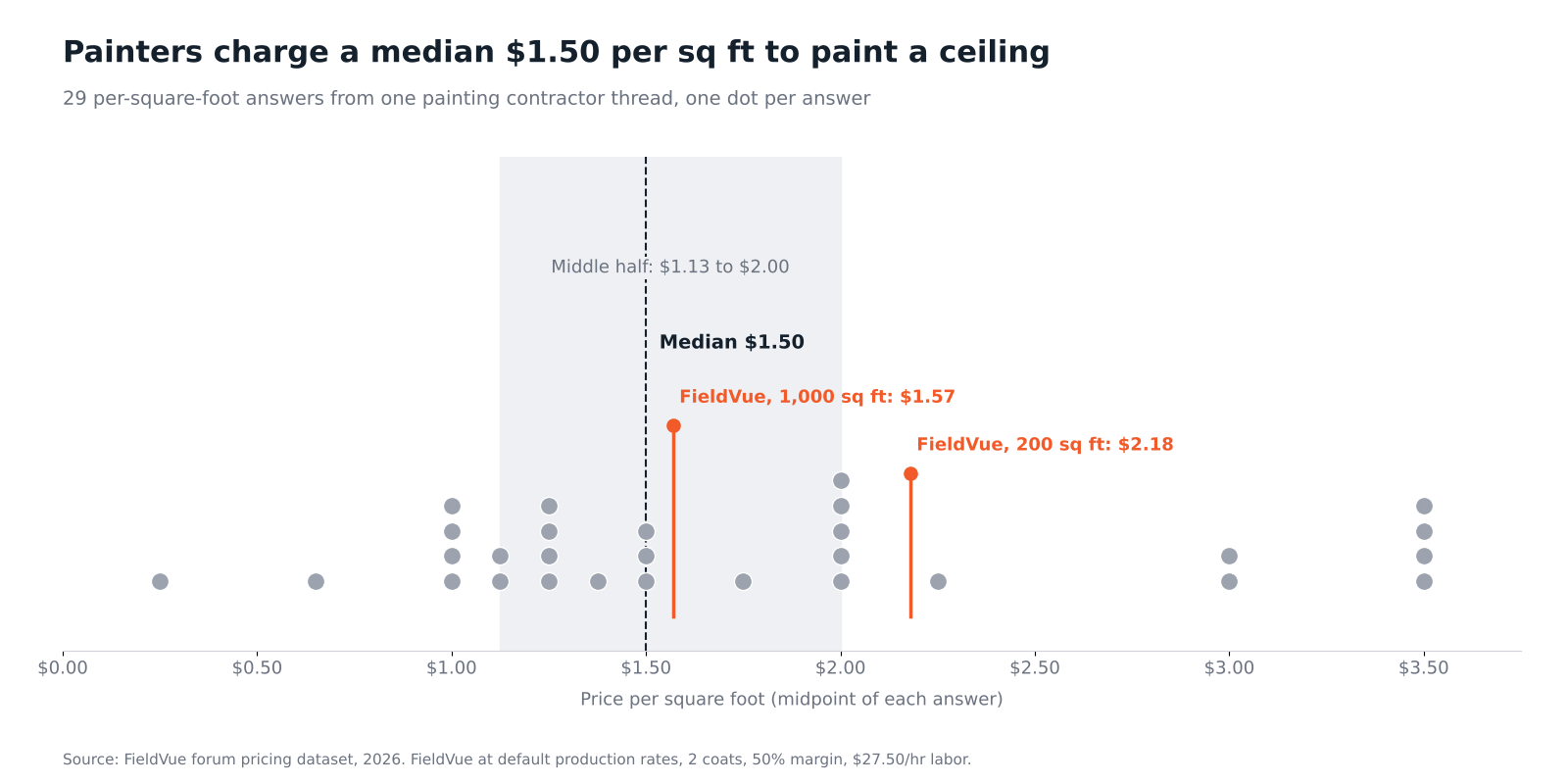
Twenty-nine painters gave a price per square foot. The middle answer was $1.50. Half of them landed between $1.13 and $2.00. The rest spread out from a quarter a foot to $3.50.
The other answers split into two camps that won’t price by the foot at all:
- By the day or a minimum (11 painters). Day rates ran from $600 to $850. The most common minimum was $350. One painter put it plainly: under four hours is $300 plus materials, over four hours is $500.
- Flat per ceiling or per room (8 painters). Mostly $100 to $220 a ceiling, a couple of $400 to $500 rooms.
The painters who did price by the foot added their own adjustments:
- More for height, like $0.25 for every 2 feet over 8
- More for color changes or dark ceilings, $2.00 and up
- $0.50 a foot extra when it needs primer
- More when the furniture is still in the room
Every one of those adjustments is real. The problem is that each painter applies a different set of them, to a different base number, and calls the result “what a ceiling costs.”
Why nobody agrees on ceiling prices
It’s not the market. A ceiling in Ohio and a ceiling in Virginia don’t take different amounts of time to roll. What’s different is what each painter bundled into “a dollar fifty.”
Coats. Only 2 of the 29 per-foot answers said how many coats they were pricing. That’s the single biggest driver of hours. One coat and two coats are not a little different. The second coat is close to half again the time.
Primer. Some include it, some add $0.50 a foot, most don’t say. A ceiling with water stains or a color change needs it.
Labor rate. A painter paying himself $25 an hour and one paying $40 can quote the same job at the same speed and land a dollar a foot apart.
Paint or no paint. At least one answer was labor only, customer buys the paint. That’s a different number wearing the same label.
Job size. This is the one almost nobody says out loud. A dollar fifty a foot works on a whole house of ceilings. It falls apart on one bedroom, which is why a third of the thread switched to minimums.
Put those together and the spread makes sense. It isn’t fifty opinions about what a ceiling is worth. It’s fifty different math problems that all got called the same thing.
What the math says a ceiling should cost
So I ran it. A 1,000 square foot ceiling job, two coats, flat ceiling paint, through FieldVue with its default production rates and a 50% margin. The only number I set was my own labor rate, $27.50 an hour.
| Line | How it’s figured | Cost |
|---|---|---|
| Labor | 1,000 sq ft at 50 sq ft an hour for 2 coats = 20 hours × $27.50 | $550.00 |
| Paint | 2,000 sq ft of coverage ÷ about 375 per gallon = 5.3, buy 6 gallons at $25 | $150.00 |
| Sundries | Tape, plastic, rollers; the $50 minimum applies | $50.00 |
| Cleanup | 1 hour per 16 worked = 1.25 hours × $27.50 | $34.38 |
| Cost | What the job takes out of the business | $784.38 |
| Price | Cost ÷ (1 − 50% margin), rounded to $5 | $1,570.00 |
That’s $1.57 a square foot, seven cents from the middle of the thread. Out of the box, the method lands where the painters who know their numbers already are.
The difference is that every piece of it is visible, and every piece is yours to change. The 50 square feet an hour is a default, not a rule. If your crew is faster, set it faster. If you pay more, the labor rate moves the price, and it moves it predictably:
| Your labor rate | 1,000 sq ft, 2 coats | Per sq ft |
|---|---|---|
| $25.00 | $1,465 | $1.47 |
| $27.50 | $1,570 | $1.57 |
| $30.00 | $1,675 | $1.68 |
That’s the point of pricing from a cost. When someone asks where your number came from, you have an answer that isn’t “that’s what I charge.”
The small-job trap
Now the same method on one 200 square foot bedroom ceiling:
| Line | 200 sq ft ceiling | 1,000 sq ft of ceilings |
|---|---|---|
| Labor | 4 hours, $110.00 | 20 hours, $550.00 |
| Paint | 2 gallons for 1.1 needed, $50.00 | 6 gallons, $150.00 |
| Sundries | $50.00 (minimum) | $50.00 (minimum) |
| Cleanup | $6.88 | $34.38 |
| Price | $435 | $1,570 |
| Per sq ft | $2.18 | $1.57 |
Same rates, same margin, and the small ceiling comes out 61 cents a foot higher. Nothing is padded. You still buy whole gallons, you still use a roll of tape and a sheet of plastic, and you still drive there, set up and clean up. On a small job, those fixed costs get spread over less ceiling.
That’s exactly why a third of the thread quoted minimums instead of a rate. The painter charging “$350 minimum plus materials” would land around $400 on this ceiling, right next to the math.
The painters quoting $100 a ceiling are the ones losing money. At $1.50 a foot this ceiling is $300, which doesn’t cover four hours of labor, two gallons and the trip at a real margin.
The fix is to set a minimum on purpose, not discover one by accident. Decide what a trip costs you, put it on the quote as a mobilization or minimum charge, and let the per-foot math handle everything above it.
How to price a ceiling yourself
- Measure the ceiling. Length times width, per room. A 12×14 bedroom is 168 square feet.
- Decide the coats. One coat for a same-color refresh in good shape, two for most repaints, primer plus two for stains, color changes or bare drywall.
- Turn it into hours. Square feet divided by a production rate. FieldVue’s defaults for a smooth ceiling up to 9 feet are 75 sq ft an hour for one coat, 50 for two, and about 31 for primer plus two. Those are whole-task rates: cutting in, masking, moving the ladder and every coat. If someone tells you they roll 80 an hour for two coats, ask whether that includes the cut line.
- Price the hours at what they cost you. Not your wage. Your wage plus payroll taxes, workers comp, insurance and the time nobody pays for. That’s usually 25 to 40 percent more than the hourly number.
- Add paint from coverage. Square feet times coats, divided by the coverage on the can, rounded up to whole gallons.
- Add sundries, cleanup and a minimum. Sundries tied to labor hours with a floor, about an hour of cleanup for every 16 worked, and a trip or minimum charge if the job is small.
- Price from your margin. Cost divided by one minus your margin. At 50%, that’s cost times two. Not cost plus 50%, which is only a 33% margin.
Then adjust the hours for what’s different about this ceiling. These are the multipliers FieldVue uses:
| Condition | Hours × |
|---|---|
| Empty room | 0.92 |
| Lived-in room (the baseline) | 1.00 |
| Light texture | 1.05 |
| 10 to 12 ft | 1.05 |
| Heavy contents in the room | 1.08 |
| Vaulted or sloped | 1.10 |
| Tray ceiling | 1.12 |
| 13 to 16 ft | 1.15 |
| Occupied while you work | 1.15 |
| Coffered | 1.22 |
| Two-story, 17 to 24 ft | 1.25 |
| Scaffold required | 1.40 |
They stack. A vaulted ceiling at 14 feet in a furnished living room is 1.10 × 1.15 × 1.08, about 37 percent more time than a flat 8-foot bedroom. That’s why “add a quarter every two feet” gets close on height but misses everything else.
Popcorn is its own job. Scraping or sealing it should be priced as a separate line, not folded into the paint rate.
The same method prices walls, trim and doors too: see the 7-step production-rate method, or run a whole room through the free interior estimate calculator.