
Most painters charge around $4 per square foot of floor to repaint an interior, or about $1.50 per square foot of wall. Those are the middle answers from four painting contractor threads, roughly 180 answers in all.
The two numbers sound like they disagree. They don’t. They’re measuring different things. A room has two to three times more wall than floor, so a floor price and a wall price for the same job land about three times apart.
Mixing them up is how painters underbid. This post shows what painters actually charge on each basis, why floor pricing breaks on repaints, when it works, and how to estimate a paint job by square feet so the number holds up.
What painters charge per square foot
Painters who price by the floor charge a median $4.15 a square foot for an interior repaint, and half of them land between $3.00 and $5.06. Painters who price by the wall charge a median $1.50 a square foot for two coats, materials included.
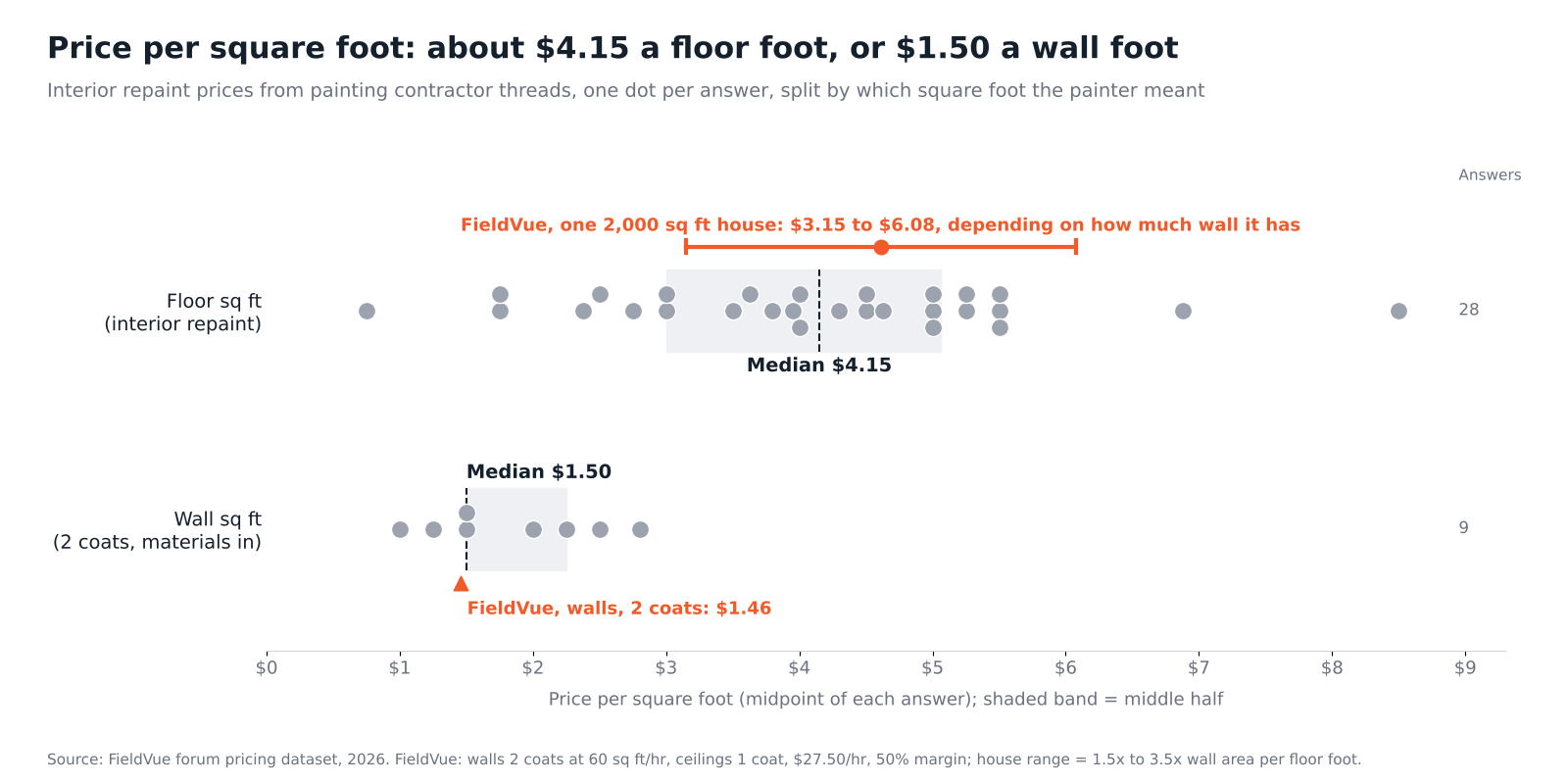
The floor answers ran from $0.75, from a painter who said he prices that low to compete with the local handyman, to $8.50. The wall answers ran from $1.00 to $2.80.
Location explains some of the spread:
| Market | Floor price per sq ft |
|---|---|
| South Florida | $3.80 |
| Louisiana | $4.50 base, up from there with prep |
| Texas | $2.75 to $4.50, and $5 to $6 with materials |
| Wisconsin | $2 to $3 plus materials |
| Minnesota | $2.75 flat sheen, $3.25 eggshell |
On the wall side, one painter near Minneapolis starts at $1.60 for one coat in the same color and goes to $4 for primer and two coats. Xactimate’s figure for two coats in Arkansas was $1.14, plus $0.35 for floor protection. When one painter asked whether $1.50 per wall foot was reasonable, most said yes for two coats. One said he doesn’t get out of bed for it.
The biggest group didn’t give a number at all. In a thread asking which square foot painters prefer, 23 of 58 said neither. They price from hours and materials. The most-liked reply in another thread: “That’s like asking how much a red car is.”
Why floor square feet breaks on repaints
You don’t paint the floor. Floor area only stands in for the walls, and the amount of wall behind a square foot of floor swings widely from house to house.
One painter laid it out: a 12×12 room with 8-foot ceilings has 384 square feet of wall over 144 square feet of floor, or 2.7 to 1. An older three-bedroom built from rooms like that comes to about 2,700 square feet of wall. Open the living, dining and kitchen into one space and the same footprint drops to about 2,300. Another painter has done 1,200 square foot houses with 2,500 square feet of wall, and others “chopped up” to 4,500.
Here is what that does to the price of one 2,000 square foot house, walls two coats and ceilings one coat, priced the same way every time in FieldVue at $27.50 an hour and a 50% margin:
| Wall per floor foot | Wall area | Labor hours | Price | Per floor sq ft |
|---|---|---|---|---|
| 1.5× (open plan) | 3,000 sq ft | 77 | $6,295 | $3.15 |
| 2.0× | 4,000 sq ft | 93 | $7,795 | $3.90 |
| 2.5× | 5,000 sq ft | 110 | $9,220 | $4.61 |
| 3.0× | 6,000 sq ft | 127 | $10,645 | $5.32 |
| 3.5× (chopped up) | 7,000 sq ft | 143 | $12,150 | $6.08 |
Same floor, same rates, almost double the price. A single floor rate is right for one of those houses and wrong for the rest. That’s the orange bar on the chart above: one house, five honest prices.
Repaints add what floor area can’t see at all: furniture, patching, color changes, a dog to work around. “A wall half the size, but you have to move furniture, you’ll be on a ladder, and they have four windows and two doors to cut around, it’s gonna take double the time.” A wall price at least scales with the paint. A floor price doesn’t scale with anything you actually do.
There’s money in this, too. At the painters’ median wall price of $1.50, a typical 2.5× house comes to $3.75 per floor foot for the walls alone, before ceilings, trim and doors. The floor-price median of $4.15 often covers the ceilings too, and sometimes trim and doors. Floor pricing quietly assumes a house with less wall than most have, and the painter eats the difference.
When floor pricing works
Floor pricing isn’t wrong everywhere. Painters who defend it mostly describe the same three situations.
- New construction. Empty houses, fresh drywall and one process repeated across a builder’s plans. “We really only use square feet for new construction homes because the process is almost always the same.” Prices there ran from $2.50 to $7 per floor foot; one painter in Illinois quotes a new 3,000 square foot house at $7, or $21,000, with Benjamin Moore materials.
- Single-story exteriors. A 1,000 square foot ranch has about 126 feet of perimeter, so 9-foot walls give roughly 1,100 square feet of siding. Floor and wall area come out close. Add a second story, gables or a long, narrow footprint and that stops being true. In a thread on exactly this question, 16 of 26 painters said measure the walls instead.
- As a cross-check. “I use square feet only as a cross-check. All my quotes are based on labor plus material.” One painter writes an estimate at $2, $3 or $4 a foot depending on prep, then a second one from hours at $85 an hour, and says the two usually match. That’s the real lesson: a square-foot price works when it’s a production rate in disguise.
How to estimate a paint job by square feet
Measure every surface you’ll paint, turn the square feet into hours, price the hours and materials, then divide by one minus your margin. Here it is on one 12×12 bedroom with 8-foot ceilings, walls two coats and the ceiling one coat.
- Measure the walls. Perimeter times height, room by room: 48 feet × 8 feet = 384 square feet. Many painters leave doors and windows in, because the extra covers cutting in around them.
- Measure the ceilings. Length times width: 144 square feet. This is the one place floor area is the right number.
- Count trim and doors separately. Baseboard and casing by the linear foot, doors by count. They don’t belong in a square-foot rate.
- Turn square feet into hours. Square feet ÷ your production rate. FieldVue’s defaults are 60 square feet an hour for two coats on walls and 75 for one coat on ceilings: 6.4 + 1.9 = 8.3 hours.
- Price the labor at what it costs you. 8.3 hours × $27.50 = $229.
- Add paint from coverage. Square feet × coats ÷ about 375 per gallon, rounded up: 3 gallons of wall paint and 1 of ceiling paint, $145.
- Add sundries and cleanup. Tape, plastic and roller covers ($50 minimum), plus about an hour of cleanup for every 16 worked ($14). Total cost: $438.
- Divide by one minus your margin. $438 ÷ (1 − 0.50) = $880.
- Check it per square foot. $880 is $2.29 per wall foot or $6.11 per floor foot. Small rooms run high per foot because whole gallons and minimums don’t shrink with the room. On a whole house the same rates come to about $1.46 per wall foot.
That last step is where square-foot pricing earns its keep: as a check on the hours, not a replacement for them. If your number lands far outside $1 to $3 a wall foot for two coats, look again at your production rates, your labor cost or your margin.
Want it done for you? The free interior estimate calculator runs this math room by room, and the interior estimate template does it in a spreadsheet you can keep.