
We have run jobs where the crew spent two or three days on prep before anyone opened a can. Washing, caulking, carpentry, re-nailing, patching, masking. Real work, real hours, all of it on the clock.
Open transitions where trim meets siding can eat a case of caulk on their own. On Hardie siding that was caulked at the butt joints years ago, the caulk cracks, and it all has to come out and go back in. (Where there’s flashing behind the joint, we don’t caulk butt joints at all; that’s per Hardie’s own installation guidance.) None of that is painting. All of it is labor.
We make money on those jobs anyway, because the quote saw the prep coming before we ever started.
None of that shows up in the finished photo. The homeowner sees clean lines and good color. They don’t see the hours underneath it that made the color last.
That is exactly why prep is the easiest place to lose money on a paint job. It is invisible to the customer, easy to round down in the driveway, and it scales with conditions nobody can see from the street. Miss it in the quote and it doesn’t disappear. It comes out of your margin, one hour at a time.
What counts as prep
Prep is everything that has to happen before the finish coat can do its job. On a repaint, it usually falls into a few groups.
Protecting what isn’t getting painted
- Moving and covering furniture
- Floor paper or drop cloths, taped down
- Masking trim, glass, fixtures, cabinets and countertops
- Plastic over windows, doors and landscaping on an exterior
Getting the surface ready
- Washing: pressure washing exteriors, degreasing kitchens and bathrooms
- Scraping and sanding failing paint
- Patching nail holes, dents and cracks
- Caulking gaps at trim, corners and siding laps
- Spot priming, or full priming over stains, bare wood and patches
Fixing what’s underneath
- Replacing or filling rotten wood
- Treating rust on steel lintels and railings
- Mildew treatment
- Repairing drywall damage beyond a quick patch
And setup and teardown every single day: unloading, laying out, cleaning up, loading back out. On a multi-day prep job, that alone adds up to a real number.
Why prep gets underpriced
It hides on the walk. Chalking, loose paint under the surface, soft wood behind a downspout, old oil under new latex. Half of it you only find when you put a scraper or a fingernail to it.
It gets bundled into “paint the walls.” A quote that says paint exterior, two coats has no line where prep lives. So when the prep doubles, there’s nothing to point to.
Published rates leave it out. A roller speed is not a production rate. A rate you can actually price off is blended: it includes routine prep, cut-in and roll time. But only routine. More on what a rate has to include.
It’s the easiest number to shave. When you’re trying to win the job, prep is where the estimate gets trimmed, because the homeowner can’t see it and won’t miss it. Until the third winter.
It varies more than anything else on the job. Two houses with the same square footage can need wildly different prep. The paint and the coats are roughly the same. The hours aren’t.
What 24 hours of missed prep does to a 50% margin
Take an exterior repaint. You walk it, figure 40 hours of painting and 8 hours of prep, and price it at a 50% margin. Loaded labor is $30 an hour, materials are $900, and sundries and cleanup follow the labor hours.
Then the crew starts scraping and finds the trim is worse than it looked. Prep runs 32 hours instead of 8. You also buy another $150 in caulk and primer.
| What you quoted | What the job took | |
|---|---|---|
| Labor hours | 48 | 72 |
| Labor ($30/hr loaded) | $1,440 | $2,160 |
| Materials | $900 | $1,050 |
| Sundries ($1.55/labor hr) | $74 | $112 |
| Cleanup (1 hr per 16) | $90 | $135 |
| Cost | $2,504 | $3,457 |
| Price | $5,010 | $5,010 |
| Gross profit | $2,506 | $1,553 |
| Margin | 50% | 31% |
Same price, same paint, same house. Twenty-four hours you didn’t see cost $952 and took the job from a 50% margin to 31%.
That is the job a lot of painters remember as “we did fine on that one.” They did. They just did a third worse than they planned, and nothing in the quote told them why.
The math behind the price, if you haven’t seen it: price = cost ÷ (1 − margin).
Three ways to price prep
Not all prep should be priced the same way. Match the method to the kind of prep.
1. Routine prep: inside the production rate. The bare minimum should still be a good paint job. So a rate you price off has to carry the work that happens on every job, not just the paint going on. FieldVue’s rates are blended for exactly that reason. Each one includes:
- Covering and moving furniture
- Paper on the floors
- Pulling outlet and switch covers
- Baseline patching and caulking
- Cut-in time
- Roll time
A wall rate of 60 sqft an hour at two coats isn’t a roller speed. It’s the whole routine job, done properly, at a normal pace. Don’t add that prep on top; it’s already in there.
The rate also doesn’t care whether you roll or spray. We apply both ways depending on the job, and the routine prep is the same either way. A blended rate covers the production pace regardless of how the paint goes on.
The point of a blended rate is that your baseline price already describes a quality job. You only adjust when the job asks for more than that.
2. Harder conditions: variants on the rate. Variant multipliers kick in when a job goes beyond routine: scraping and sanding instead of a quick patch, access past a normal ladder, landscaping in the way. The rate slows down to match. Grade it on the walk, surface by surface. In FieldVue they apply to each service item, and they stack:
- Prep complexity: Light (wash and minor scrape), Moderate (scrape, sand, caulk, spot prime) or Heavy (extensive failure, oil prime)
- Coats: 1, 2 or prime plus 2. Bare wood, patches and stains need the prime.
- Access: ground, ladder (10–16 ft), two-story (17–24 ft), roof access, scaffold or lift
- Surface: simple and flat, standard and profiled, or complex and detailed. Rough-sawn cedar, stucco and bare masonry drink paint, so they cover slower and take more gallons.
- Site friction: furniture to work around, landscaping, tight spaces, a family living in the house
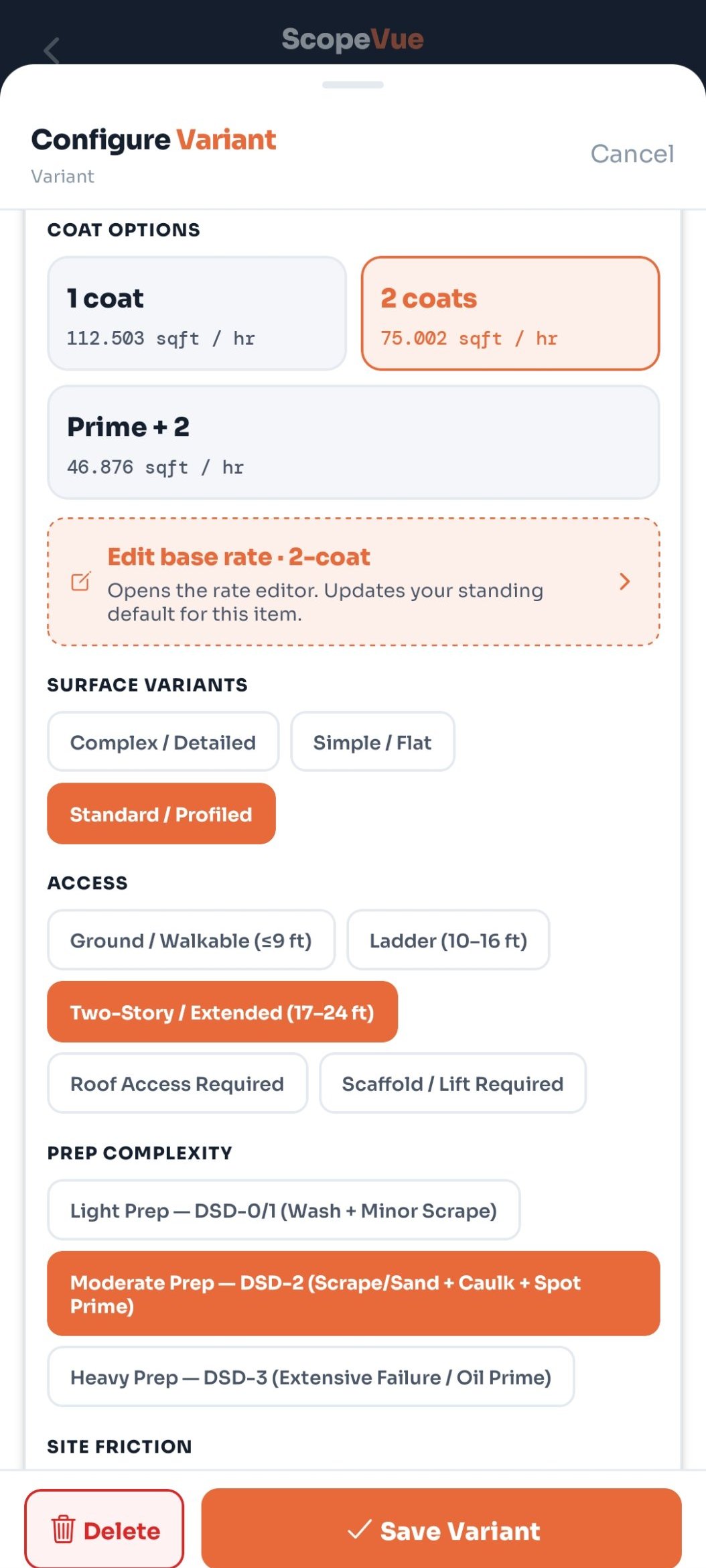
Same siding, different job: coats, access and prep all change the rate.
A moderate-prep wall on a two-story elevation takes far longer per square foot than a light-prep wall you can reach from the ground. The quote should know the difference before you send it.
3. Its own scope: a separate line item. Some prep is a job in itself. Price it by its own unit so it’s visible and defensible:
| Prep line item | Priced by |
|---|---|
| Caulking | Linear feet (its own line item in FieldVue) |
| Drywall patching | Square feet |
| Wallpaper removal | Square feet |
| Stain-blocking prime | Square feet |
| Wood rot repair | Each, or hours |
| Rust treatment on lintels and rails | Each, or linear feet |
The rule of thumb: if a homeowner could reasonably ask “what’s that for?”, give it a line.
Some jobs are mostly prep. Popcorn ceiling removal is scraping, skimming and containment before a drop of paint goes on, and on kitchen cabinets the degreasing, sanding and labeling take as long as the coats. Stained doors going white need a stain-blocking primer priced as its own step.
Sundries follow the prep
Prep doesn’t only eat hours. It eats supplies: caulk by the case, sandpaper, scraper blades, plastic, tape, floor paper, primer, patch, rags.
That’s why sundries should follow labor hours, not a percentage of the paint. A prep-heavy job might use the same paint as a light one and three times the tape. We use $1.55 per labor hour, with a $50 floor, and it scales with the work.
FieldVue does this automatically. Sundries and cleanup are calculated from the job’s labor hours, so when prep adds hours, sundries rise with them. And because they sit in the cost basis, your margin applies to them too. They’re priced, not just covered.
The same goes for cleanup. More days on site means more setup, more teardown and more load-outs. Roughly one hour of cleanup for every 16 hours of work keeps that on the clock instead of on you.
What to check on the walk
You can’t price prep you didn’t see. Spend the extra ten minutes:
- Run a hand across the siding. Chalk on your palm means washing and possibly priming.
- Press a scraper or a fingernail into peeling areas. How far does it lift?
- Look at the bottom edges of laps and boards, and around gutters and downspouts. That’s where rot starts.
- Check every caulk joint at trim and corners. Cracked or shrunk means a full re-caulk, priced in linear feet.
- Look for rust on steel lintels, railings and fasteners.
- Note mildew, especially on north-facing walls and under eaves.
- Ask what’s on there now. Oil under latex changes the prime.
- Inside: count the nail holes and dings, check the kitchen for grease, and note how much furniture has to move.
Put the prep in the quote
Once you’ve priced it, write it down. “Scrape and sand all failing areas, re-caulk trim, spot prime bare wood” tells the homeowner what they’re paying for. It also protects you when they ask why the price is higher than the next guy’s.
It’s the clearest difference between a professional quote and a number on a business card. Here’s what a full quote should include.
And when you find more than you quoted after the work starts, that’s a change order, in writing, before you do it. Not a donation.