
To quote a painting job, walk it, measure what you’ll paint, turn it into hours, price the hours and materials from your margin, then put the scope in writing before you send the number. That’s the short version. The long version comes from more than 150 painters in contractor threads, most of whom learned it by underbidding first.
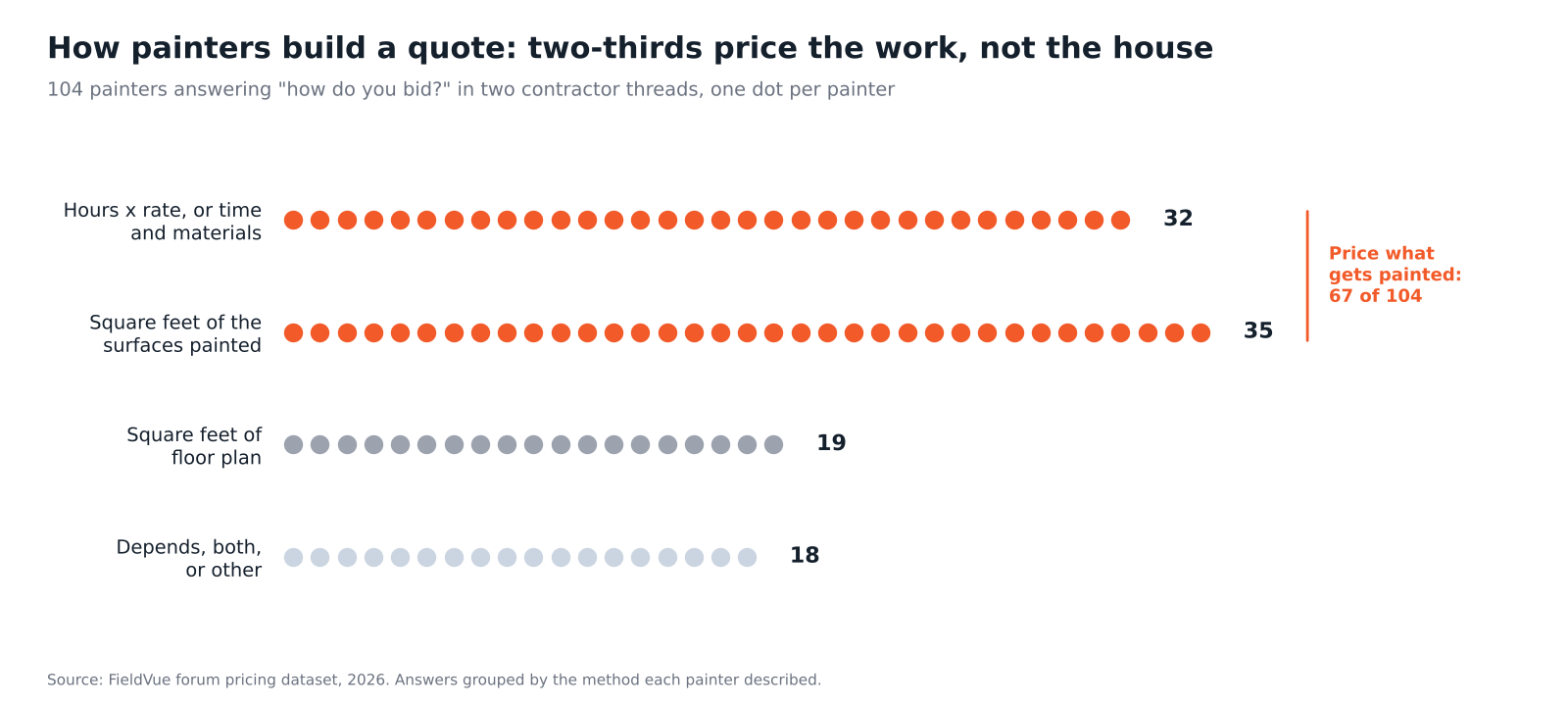
When painters were asked how they bid, two-thirds said they price the work itself: the hours it takes, or the square feet of the surfaces they’ll paint. About one in five still price off the floor plan, mostly on new construction.
One painter summed it up in four words: “Every job is unique.” The nine steps below are how the experienced ones turn that into a number they can stand behind.
How to quote a painting job, step by step
1. Walk the job before you give a number
Asked whether they price by floor or wall square footage, one painter answered neither: “Physically go and look at it. Repaints can have holes in the walls and a lot of prep. Never bid by the square foot.” Phone and photo quotes skip the things that set the price: the condition of the old paint, the furniture, the height, the patching.
Check the surprises while you’re there. On a popcorn ceiling, wet a spot to see whether it was painted, and test anything installed before the mid-1980s for asbestos. On stained doors, plan on an oil or shellac primer. One painter tested a popcorn corner that scraped easily, then found the rest had to be chiseled: “a three-day job that took two weeks.”
2. Measure the surfaces, not the house
“You’re not painting the floor square footage. Just take accurate measurements of the surface you’re painting.” Walls are length times height, ceilings length times width, trim by the linear foot, doors by count. “Get a laser measurement tool. They’re $20.”
Floor area hides how much wall a house has. One painter has seen 1,200 square foot houses with 2,500 square feet of wall and others with 4,500. More on that in how much to charge per square foot.
3. Turn the measurements into hours
“The real question is man-hours per square foot.” Divide each surface by your production rate for that surface and coat count, and add hours for prep you saw on the walk. Second-story trim, cut-up rooms and occupied homes all run slower.
Hours do double duty once the job is sold: “It gives us a goal to hit for hours on the job and bonus potential for my team.” See production rates explained.
4. Price the hours at what they really cost you
Your labor rate has to carry more than the wage. “Where is your added cost for insurance? What about office time?” One painter adds $200 a day as a base for lunch, gas and daily expenses. Another painter counts marketing, licensing, tools and the time spent writing estimates before setting a price.
5. Add materials, sundries and cleanup as their own lines
Paint from coverage, not from feel. Then the small stuff: “tape, paper, plastic, caulk,” which one painter prices at $200 a job. Cleanup is real labor: “Removing is hardly anything. Cleanup is a fortune.”
6. Price from your margin, not a markup
“I estimate hours and material, then double that.” Another: “I find out my cost for supplies and labor and double it, or 2.5 times the cost.” One painter targets labor at 35% of the price and materials at 15%, leaving 50% gross profit to cover overhead, his pay and a 3% net profit he moves to a separate account.
Doubling the cost is a 50% margin. Adding 50% to the cost is only 33%. That gap is covered in markup vs margin, and the full math is in the 7-step pricing method.
7. Set a minimum
Small jobs carry almost the same setup, travel and cleanup as big ones. Painters in these threads set floors on purpose: $300 for a bathroom, $2,500 to $5,250 for a cabinet job, and one won’t take a furnished popcorn bedroom under $1,500 after doing one for $1,200.
8. Write the scope and give options
Write what’s included in plain words: “Remove popcorn, skim to a smooth finish, prime and paint two coats” prevents most of the arguments. Itemize: “Every item you put paint on should be its own line item.”
Options sell. One painter discusses paint quality on every job: “They want the best, I add $2. They want the cheapest, we add .50,” on his square-foot price. On cheap flush doors, offer painting or replacing them. Put the unknowns in writing as well, so painted-over popcorn or hidden damage becomes a change order instead of your loss.
Tell the customer how to get ready, too. One crew hands out a short “How to prepare for us” list: furniture, pets, access. “I’ve never had any pushback.”
9. Check the number before you send it
“I use square feet only as a cross-check… all of my quotes are based on labor (time) plus material times overhead.” One painter writes his price two ways, by the square foot and by hours at $85 an hour, and expects them to match.
Then send it fast. Some painters finish the estimate on site: “I can estimate an entire interior in about 15 minutes and have an accurate estimate for the customer before I leave.” Others spend up to two hours on a complicated quote. Both send a number they’ve checked.
Quoting mistakes painters admit to
The most useful answers in these threads were confessions.
- Pricing from the floor plan. “It could be four walls, it could be 40. The square footage would be off by a mile. I learned everything the hard way and screwed myself for years.”
- Pricing by the square foot on repaints. “I have been burnt so many times charging by the square foot. Prep work. Cleaning up after the last guy. And 100 other factors.”
- Guessing the surface before testing it. The popcorn corner that scraped easily turned a three-day job into two weeks. Five painters in the popcorn thread said their own price had been too low.
- Pricing too low to be believed. A painter with 32 years in the trade: “I have seriously lost a few jobs because I was so low it scared the potential client.” The advice from another painter: raise prices 10% and see what happens.
- Copying someone else’s number. Asked what painters charge per square foot, one replied: “That’s like asking how much a red car is.” The same price can come from a slow painter at a low wage or a fast one at a high wage. Their speed isn’t yours.